Most businesses don’t decide to outsource their logistics. They outlive their current setup until outsourcing becomes the only option that makes sense. By then, they’ve already absorbed months of friction — staffing shortfalls, overloaded dock space, freight costs that never quite reconcile — before anyone frames the problem clearly enough to act on it.
The decision between managing logistics in-house and working with a third-party logistics provider is one of the most operationally significant choices a growing business can make. It touches labor, capital expenditure, service quality, and supply chain flexibility all at once. Getting it wrong in either direction is expensive. Understanding where the real trade-offs sit is the only way to make a defensible call.
What “In-House Logistics” Actually Looks Like
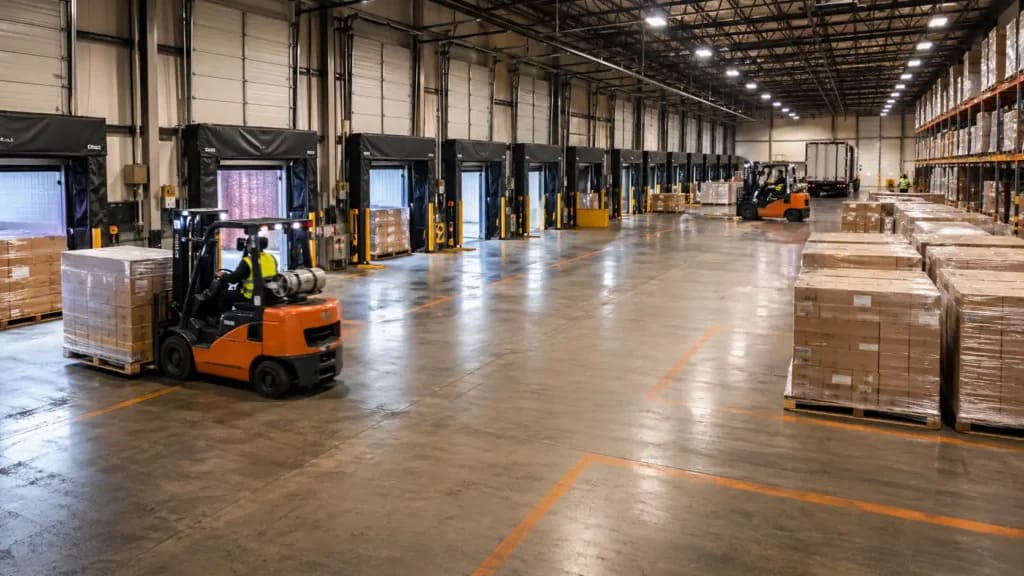
In-house logistics sounds straightforward until you inventory what it actually requires. At minimum, it means owned or leased warehouse space, a workforce to manage receiving, put-away, order fulfillment, and shipping, a transportation network — whether owned assets or broker relationships — and the management layer to coordinate all of it. For larger operations, add fleet maintenance, compliance oversight, dock scheduling systems, and carrier relationship management on top.
According to the Bureau of Transportation Statistics, logistics costs in the U.S. consistently represent a significant share of total business operating expenses, particularly in manufacturing, retail, and distribution-heavy industries. The businesses that manage those costs well are rarely the ones trying to do everything themselves.
None of this is to say in-house logistics is wrong. For some businesses, control over the freight operation is a genuine competitive requirement. But it’s worth being precise about what you’re actually managing before deciding whether the investment is worth the return.
What a 3PL Actually Does
A third-party logistics provider takes on the execution layer of your freight and distribution operation. Depending on the arrangement, that can mean warehousing and storage, cross-docking, fulfillment, carrier management, freight forwarding, or some combination. You retain the strategy and vendor relationships; the 3PL handles the physical and operational execution.
The range of what a 3PL can cover varies considerably by provider. Asset-based 3PLs own their own facilities and equipment. Non-asset-based providers rely on carrier and warehouse networks. Full-service providers offer both, along with freight forwarding, customs brokerage, and expedited shipping under one roof.
For businesses shipping into or out of the Florida and Southeast market, a 3PL in Tampa offers geographic positioning that matters — proximity to Port Tampa Bay, Tampa International Airport, and the I-4/I-75/I-275 interchange that moves freight across the state.
The Real Cost Comparison
The most common mistake businesses make when evaluating in-house versus outsourced logistics is comparing only the direct line items. The 3PL invoice looks obvious. The in-house cost is distributed across payroll, real estate, equipment, insurance, and management time — making it harder to total and easier to underestimate.
A more accurate comparison accounts for all of the following:
| Cost Category | In-House Logistics | 3PL Partner |
|---|---|---|
| Warehouse space | Lease or ownership, fixed cost regardless of volume | Variable, scales with actual usage |
| Labor | Payroll, benefits, turnover, training | Included in 3PL contract |
| Equipment | Forklifts, dock equipment, WMS software — capital outlay | Provided by 3PL |
| Carrier rates | SMB-level rates without volume leverage | Network rates from high-volume relationships |
| Flexibility | Fixed overhead regardless of peak or slow seasons | Scales up or down as needed |
| Management bandwidth | Internal team required; competes for leadership attention | Offloaded to 3PL operations team |
| Compliance burden | Internal responsibility | Shared or handled by provider |
The real comparison isn’t 3PL invoice versus nothing. It’s 3PL invoice versus the fully loaded cost of doing it yourself. For most mid-market businesses, when that math gets done honestly, the gap closes faster than expected.
When In-House Logistics Still Makes Sense
There are situations where maintaining a logistics operation internally is the right answer. Businesses that have built a competitive advantage directly tied to their distribution model — same-day delivery in a tight geography, proprietary handling protocols, or highly customized order management — often find that outsourcing introduces more risk than it removes.
Manufacturing businesses with a just-in-time production dependency and extremely tight inbound schedules sometimes find that the coordination overhead of working through a third party creates latency that their production floor can’t absorb. High-security freight — certain pharmaceutical, aerospace, or high-value electronics shipments — may have handling requirements that limit how widely the operation can be distributed.
In these cases, the argument for in-house logistics isn’t that it’s cheaper. It’s that the freight operation is core enough to the business model that control justifies the cost.
Signs You’ve Outgrown Your Current Setup
Most businesses that need a 3PL know it before they admit it. The signals tend to be consistent: freight costs that are rising without a corresponding increase in volume, warehouse utilization that’s consistently over 85 to 90 percent, a carrier pool that’s limited by your size rather than your needs, a logistics team that’s running reactive rather than strategic, or a peak season that consistently overwhelms your capacity and forces expensive short-notice solutions.
Each of these is a leverage problem. Your freight operation is consuming resources at a rate that’s disproportionate to the output it’s delivering. A 3PL fixes the leverage problem by spreading those fixed costs across a much larger operation and giving you access to capability and capacity you can’t efficiently build yourself.
The companies that benefit most from outsourcing are typically ones in a growth phase that have passed the point where the in-house setup scales cleanly. The operation is no longer small enough to run lean, but not large enough to justify the full infrastructure investment needed to run it well internally.
Cross-Docking as a Middle Ground
For businesses that don’t need full 3PL distribution management but want to reduce dwell time, warehousing overhead, and inbound handling costs, cross-docking offers a targeted solution. Rather than routing inbound freight into storage and managing it through a pick-and-pack workflow, cross-docking transfers freight directly from inbound carriers to outbound trucks with minimal handling and no storage step.
The economics work well for businesses with committed orders or distribution schedules where the freight is already spoken for before it lands. Product that’s going to a known destination doesn’t need to be warehoused. It needs to be moved. Cross-docking does that efficiently, at a fraction of the cost of full warehousing.
Adcom’s Tampa facility operates three minutes from Tampa International Airport and supports both 3PL distribution services and cross-docking under the same roof, which means businesses don’t need separate provider relationships depending on which service the freight calls for.
What to Look for in a 3PL Partner
If outsourcing is the right direction, the provider you choose matters as much as the decision itself. A 3PL relationship is an operational dependency. Choosing based on rate alone tends to result in service gaps that cost more to fix than you saved on the front end.
The factors that actually determine long-term fit include:
- Geographic alignment: Is the provider positioned where your freight actually moves? A Tampa-based 3PL should have real connectivity to Florida’s ports, airports, and major highway corridors.
- Service breadth: Can the provider handle cross-docking, short-term warehousing, expedited shipments, and air freight under one roof? Or will you need multiple providers for different freight types?
- Availability: Does the provider operate around the clock? Time-sensitive B2B freight doesn’t always arrive on a Monday morning. Emergency capability matters.
- Track record: How long has the provider been operating? In logistics, longevity reflects the kind of carrier relationships, facility investment, and operational depth that takes years to build.
- Scalability: Can the provider grow with you? A 3PL that’s the right size for your current volume but can’t handle a 30% increase creates a transition problem at the worst possible time.
A 3PL’s value often shows up in services beyond storage and transportation, such as kitting and light assembly handled before freight ever ships, and once the fulfillment side is settled, choosing between FTL, LTL, and PTL freight covers the transportation decision that comes next.
Adcom Worldwide has been operating out of Tampa for over 40 years, providing cross-docking, warehousing, expedited freight, air cargo handling, and full 3PL distribution services to B2B clients across Florida and the Southeast. The facility runs 24/7 and is positioned three minutes from TPA for businesses whose freight moves through the air cargo terminal.
If you’re working through whether outsourcing your logistics operation is the right move, Adcom can walk you through what that would look like for your freight volume and distribution requirements. Request a quote to start the conversation.