
Most freight managers treat air freight as a last resort. The rate is higher, the thinking goes, so ground wins by default. That logic is understandable. It’s also the kind of habit that puts the wrong freight on the wrong mode and creates a downstream problem that costs more to fix than the air cargo rate would have in the first place.
The real question is never whether air freight is expensive. It is. The question is whether the total cost of not using it — on a specific shipment, in a specific situation — is higher. That calculation shifts depending on what you’re shipping, where it needs to go, how fast it has to get there, and what happens to the business if it doesn’t arrive on time.
According to IATA, air cargo carries a disproportionate share of global trade by value relative to its share of total freight volume. The reason is straightforward: the freight that moves by air is often the freight where speed and reliability justify a higher rate. Understanding when your shipment falls into that category is a more valuable exercise than reflexively defaulting to ground.
What Actually Separates Air and Ground Freight at the Operational Level
Air freight and ground shipping don’t just differ in speed. They differ in how freight is handled, how predictable transit times are, and where the freight spends most of its time in the network.
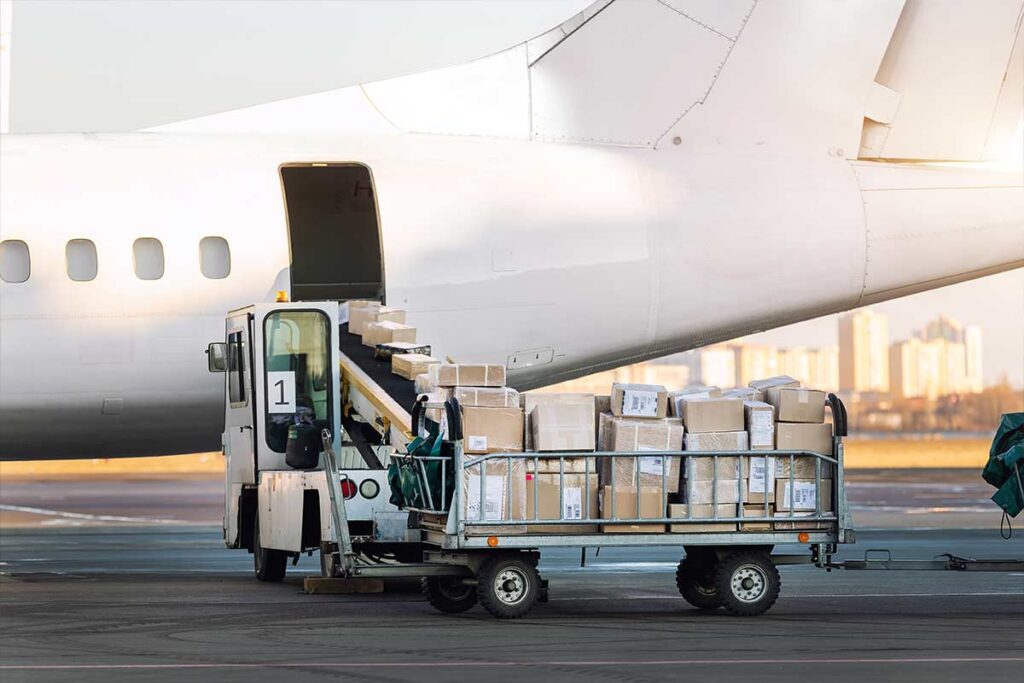
Air freight moves on a fixed flight schedule. Departure times don’t flex. Capacity per flight is limited. The freight that makes the cut moves fast and with minimal handling between origin and destination. From Tampa International Airport, domestic air cargo reaches most major U.S. markets within one to two business days. International destinations depend on routing and customs, but the speed advantage over ocean or ground holds in almost every case.
Ground shipping moves on road networks across variable conditions. A standard FTL or LTL shipment from Tampa to a distribution point in the Midwest or Northeast typically takes two to five days depending on distance and carrier routing. Ground freight absorbs more handling, more transit variability, and more exposure to weather delays and traffic disruptions. None of that makes ground shipping a bad option. It makes it a different option.
The choice between the two isn’t about which mode is better in the abstract. It’s about which one fits the actual constraints of the shipment in front of you.
How Air and Ground Compare Across the Factors That Drive Real Decisions
Rate is the obvious starting point, but it’s rarely the only factor that matters when the decision is under pressure. Here’s how the two modes compare across the dimensions that actually determine fit:
| Factor | Air Freight | Ground Shipping |
|---|---|---|
| Transit speed | 1 to 2 days domestic, faster international than ocean | 2 to 5 days depending on distance and carrier routing |
| Rate structure | Higher per pound, priced by weight and dimensional weight | Lower per pound, priced by weight, class, and distance |
| Transit predictability | High, flight schedules are fixed | Moderate, subject to road conditions, weather, and carrier capacity |
| Handling frequency | Low, minimal touchpoints between origin and destination | Higher for LTL due to terminal transfers and consolidation |
| Damage exposure | Low due to limited handling and secure cargo hold environments | Higher for LTL, lower for dedicated FTL moves |
| Best shipment size | High-value, low-volume, time-sensitive freight | High-volume, lower-value freight on open timelines |
| Cost efficiency | Justified when downtime, penalties, or delays cost more than the rate | Strong when timeline flexibility exists and volume is high |
The table doesn’t make the decision for you. It frames the decision correctly. The right mode is the one where the total cost — rate plus risk plus consequence — comes out lower.
Ground Shipping Wins on More Than Just Price
Ground freight is not simply the cheaper option you settle for when air freight isn’t justified. For most shipments, it’s the operationally correct choice.
High-volume freight that doesn’t need to move in 48 hours belongs on a truck. Raw materials, bulk inventory, store replenishment, and non-urgent distribution freight all move efficiently on ground networks at a fraction of the air cargo rate. The savings on a consistent lane over a full year are meaningful. Redirecting even a portion of that freight to air freight without a time-critical justification is a straightforward budget problem.
Ground shipping also handles oversized and heavy freight that air cargo simply can’t accommodate. Large equipment, palletized bulk product, and freight that exceeds airline dimensional or weight thresholds has no air option regardless of urgency. Ground is the only mode, and FTL and LTL freight options give shippers the flexibility to match load size to the right rate structure.
The Shipments That Almost Always Belong on a Plane
There are shipment profiles where air freight stops being optional and becomes the only defensible call. Knowing them is half the battle.
Time-critical parts are the clearest case. A manufacturing line that goes down waiting on a replacement component doesn’t measure cost in freight rates. It measures it in downtime, delayed orders, and customer penalties. When the cost of a production stoppage exceeds the air freight rate, air isn’t expensive. It’s cheap.
High-value, low-weight freight travels efficiently by air. Pharmaceuticals, medical devices, electronics, and precision components are all examples of cargo where the value density makes air freight economical on a cost-per-dollar-of-cargo basis, even when the per-pound rate looks high on the invoice.
Perishables and temperature-sensitive freight that can’t survive a multi-day ground transit also belong in the air. The same applies to time-sensitive samples, event materials, and anything with a hard arrival deadline that ground shipping’s variability can’t reliably guarantee.
Being Near Tampa International Airport Changes the Calculation
Not every air freight move is built the same. Access to a major cargo airport changes how quickly freight can be staged, cleared, and loaded — and being three minutes from Tampa International Airport creates a meaningful operational advantage for businesses moving freight through the Florida market.
Freight staged at a facility with immediate TPA proximity can move from receiving to cargo hold faster than freight that needs to travel across a metro area to reach the terminal. That window matters when air freight bookings are time-sensitive and load cutoffs are tight. It also matters on the inbound side: air cargo arriving at TPA can be picked up, cross-docked, and dispatched for regional delivery without the dwell time that accumulates when a facility sits far from the airport.
For businesses managing emergency shipping situations or time-sensitive inbound air cargo, the proximity advantage isn’t a marketing point. It’s an operational one.
For freight arriving by container rather than by air, drayage explains the short port-to-warehouse leg every import still has to make, and when neither air nor standard ground is fast enough, hot shot trucking covers the dedicated-vehicle option for genuinely urgent loads.
Ship Smarter With a Team That Knows Both Modes
Adcom Worldwide has managed air and ground freight out of Tampa for over 40 years, with a facility positioned three minutes from Tampa International Airport. Whether a shipment belongs on a plane or a truck is a question the Adcom team fields every day — and the answer is always based on what the freight actually requires, not on defaulting to the cheapest option or the fastest one.
- Air freight services support domestic and international cargo moving through TPA, with staging and cross-dock capability built into the workflow.
- Expedited freight covers time-sensitive shipments where ground is still the right mode but speed is non-negotiable.
- FTL and LTL freight services handle high-volume ground moves across Florida and the Southeast at the right rate structure.
- Emergency shipping is available around the clock when a shipment can’t wait on a standard booking window.
If you have a shipment in front of you and aren’t sure which mode makes the most sense, request a quote and the Adcom team will work through the right call with you.