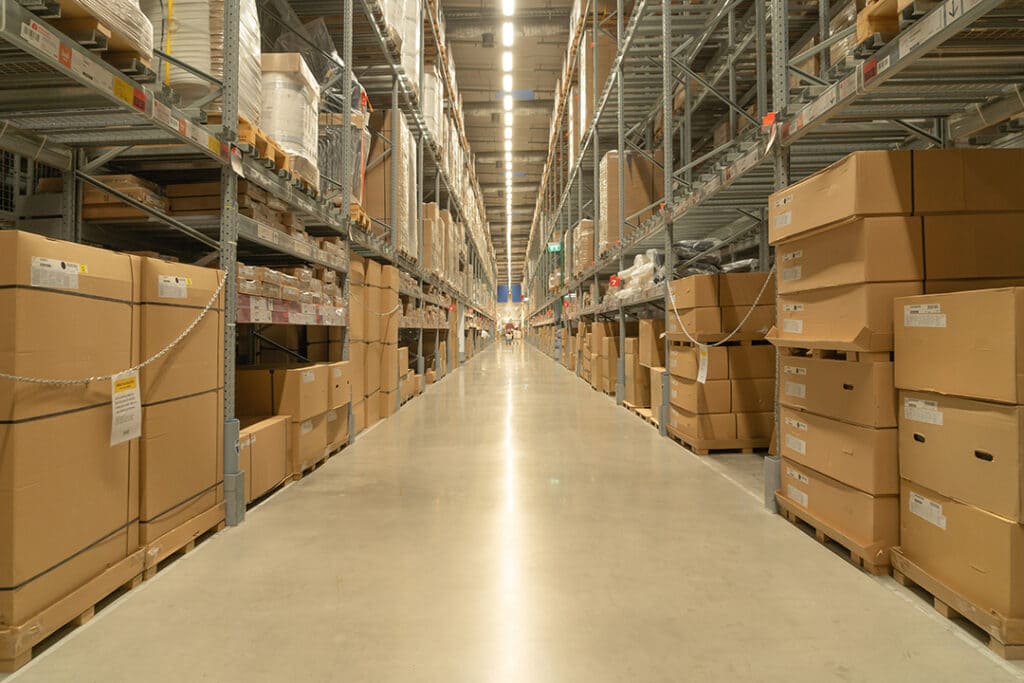
Every supply chain has a ceiling — a point where inbound volume exceeds available storage and the whole operation starts to strain. For many businesses, that ceiling gets hit at predictable times: the holiday season, back-to-school periods, annual tradeshow cycles, or the ramp-up before a major product launch. When it happens, the options are limited: turn away freight, scramble for emergency space, or have a plan already in place.
Overflow warehousing is that plan. According to the National Retail Federation, peak season freight volumes can surge dramatically above baseline for retailers and their suppliers — which means the businesses that manage peak season well are almost always the ones that planned their overflow capacity before they needed it.
What Is Overflow Warehousing?
Overflow warehousing is temporary storage space activated when a business’s primary storage location — whether an owned facility, a leased warehouse, or a 3PL’s committed space — hits capacity. Rather than turning away inbound shipments or disrupting the flow of product into the primary facility, overflow space absorbs the excess volume until demand normalizes and the backlog clears.
The arrangement is typically short-term by design. Businesses access overflow space for weeks or months, not years, and the relationship is structured to be flexible — scaling up as volume peaks and winding down as it recedes. The goal is to protect the core operation from capacity pressure without locking into a long-term commitment for space you’ll only use part of the year.
Industries That Rely on Overflow Warehousing
Overflow warehousing comes up across a wide range of industries, but it’s especially critical in retail and ecommerce, construction and building materials, hospitality and FF&E logistics, and manufacturing businesses with seasonal production cycles. Retailers building Q4 inventory often need 30–50% more space than their off-peak baseline. Construction companies staging materials ahead of a job start need a temporary home for product that can’t go to the job site yet. Tradeshow logistics coordinators need staging space close to convention venues before and after events.
What all of these share is a demand pattern that makes permanent overcapacity wasteful and undercapacity dangerous. Overflow warehousing threads that needle — you pay for what you need when you need it, without carrying the cost of excess space through the slow months.
How Cross-Docking Reduces Overflow Pressure
One strategy that reduces overflow demand before it builds is incorporating cross-docking into your inbound freight process. Instead of receiving product into storage and waiting for it to be dispatched, cross-docking routes inbound freight directly to outbound trucks with minimal dwell time. For product that’s already committed to orders or distribution points, this eliminates the storage step entirely — reducing the volume that accumulates in your primary facility and lowering the threshold at which overflow becomes necessary.
Cross-docking and overflow warehousing work well together as a two-layer approach: cross-docking handles high-velocity committed freight immediately, while overflow space absorbs the inventory that genuinely needs to sit before it can move. Adcom’s Tampa facility supports both, which means businesses don’t have to choose between speed and storage capacity.
Choosing an Overflow Location: What Matters
Not all overflow space is equal. A facility that’s far from your primary distribution point adds transportation cost and transit time to every move between locations. One that’s close — ideally integrated with the same logistics provider managing your primary flow — reduces those friction points substantially.
Adcom’s Tampa warehouse is positioned three minutes from Tampa International Airport and close to the I-4, I-75, and I-275 interchange, making it a practical overflow option for businesses whose primary distribution runs through the Southeast corridor. Freight staged at Adcom can move efficiently to Central Florida, South Florida, or north along the I-75 corridor without adding meaningful time to the supply chain.
Planning Overflow Capacity Before You Need It
The worst time to look for overflow warehousing is when you already need it. Space fills up during peak periods — the same demand surge driving your overflow need is driving overflow need for every other business in the region. Businesses that wait until capacity pressure is acute often find limited availability, higher short-notice rates, and facilities that aren’t set up to handle their freight type.
The better approach is to establish an overflow relationship during a slow period, understand exactly how activation works, and have the logistics ready to move when the surge hits. If you’re still working through the baseline warehousing question — whether short or long-term storage makes sense as your foundation — our earlier article on short-term vs. long-term warehousing is a useful starting point before layering in overflow planning.
Adcom’s warehousing and distribution team can walk through your peak season timeline, your inbound volume projections, and what overflow activation would look like for your operation. Call 813-887-3747 to speak with someone directly, or request a quote and we’ll follow up to discuss your needs.
Businesses scaling into new regions without committing to a lease can start with regional distribution through a 3PL, and for overflow freight that happens to be temperature-sensitive, cold warehousing distribution covers what that storage needs to look like.