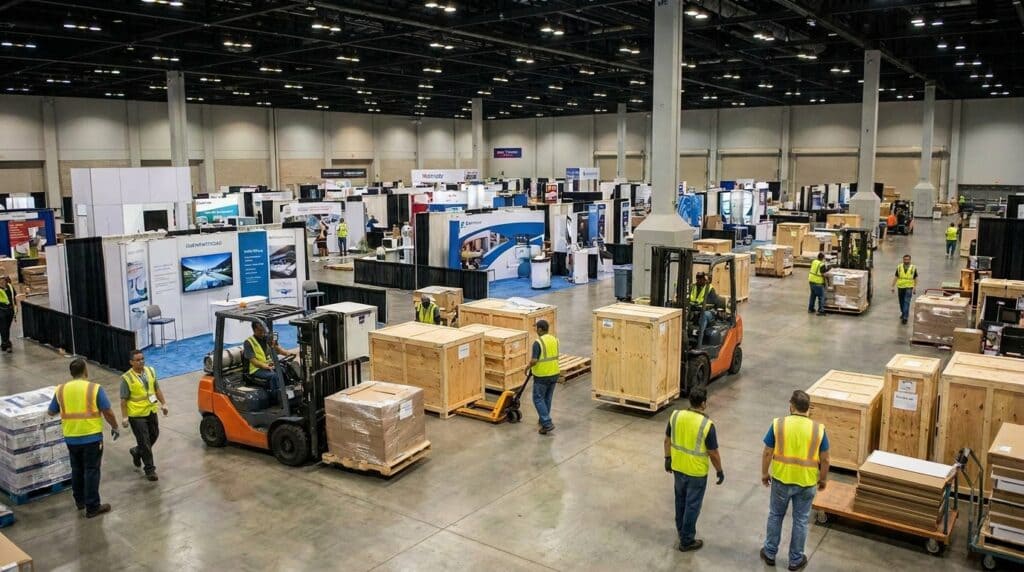
Tradeshow logistics is one of the more unforgiving corners of the freight world. Exhibits, displays, crates, and promotional materials have to arrive on time, intact, and ready to set up — and when the show ends, they have to move out just as efficiently. There’s no buffer for a missed delivery, no workaround for damaged displays, and no recovering from a booth that never showed up. For businesses that participate in tradeshows regularly, logistics isn’t a background task — it’s a make-or-break part of the event.
According to Exhibitor Magazine, exhibit freight is among the most time-sensitive and damage-prone categories in logistics — and also one of the most expensive when things go wrong. Getting it right requires more than booking a carrier. It requires a coordinated plan that covers storage, transit timing, on-site handling, and the return trip.
The Tradeshow Freight Timeline
Most tradeshow logistics problems trace back to timing. Convention centers and show organizers operate on tight schedules — advance warehouse windows, target freight delivery dates, and move-out deadlines are firm. Freight that arrives outside the advance warehouse window may be turned away or assessed penalty fees. Freight that misses the move-out window can be abandoned or shipped at the exhibitor’s expense via a drayage company’s rates, which are rarely favorable.
A realistic timeline works backward from the show’s target delivery date. Factor in production time for any custom displays, transit time from your facility or supplier to the staging location, time in advance warehousing, and drayage to the booth. On the back end, plan for freight pickup the same day or the morning after breakdown, and a clear path back to storage or your primary facility. Leaving any of these steps to chance is where costs spike.
Why Advance Warehousing Matters
Most large tradeshows offer an advance warehouse option — a facility designated to receive freight before the show opens, then deliver it to booths during setup. Using the advance warehouse is almost always preferable to direct-to-show shipping, which requires precise timing and carries a higher risk of missed delivery windows.
The challenge is that advance warehouses have their own deadlines, storage limits, and handling fees. Many exhibitors find it more cost-effective to use a local third-party warehouse near the show venue as a staging point — receiving freight well in advance, holding it in a controlled environment, and coordinating final delivery to the advance warehouse or directly to the show floor on a tighter, more predictable schedule.
For tradeshows moving through Tampa and the broader Southeast corridor, Adcom’s Tampa warehouse functions as that staging hub — receiving exhibit freight, holding it until the delivery window opens, and coordinating outbound dispatch to the venue.
Managing High-Value and Fragile Exhibit Freight
Tradeshow freight often includes items that don’t tolerate rough handling well — large format graphics, custom display structures, electronics, and branded materials that can’t easily be replaced on short notice. Standard LTL shipping, which involves multiple handling touches and shared trailers, isn’t always appropriate for this type of freight.
For time-sensitive or fragile exhibit shipments, expedited freight with dedicated handling is worth the additional cost. A dedicated truck eliminates the multi-touch exposure of LTL, keeps your freight with a single carrier from origin to destination, and gives you better visibility into transit status. For the tightest windows — same-day or next-day delivery requirements — same-day cross-docking in Florida can bridge the gap between an inbound shipment and an outbound delivery without overnight storage.
The Return Trip: Don’t Leave It as an Afterthought
Post-show freight is where exhibitors most often lose money. In the chaos of breakdown, outbound logistics planning falls apart — freight gets consolidated incorrectly, carriers aren’t pre-arranged, and companies end up paying premium rates for last-minute moves. Some simply abandon low-value items rather than deal with the logistics, which becomes a pattern that adds up over a full show calendar.
The return trip deserves the same planning as the inbound move. Pre-arrange your carrier before the show, confirm the pickup window, and have a clear destination — whether that’s back to your primary warehouse, to your next show location, or into storage at a facility near the venue. Adcom’s cross-docking capability supports outbound consolidation after shows — multiple pieces of exhibit freight can be received, sorted, and redirected to different destinations without full warehousing storage in between.
Building a Repeatable Tradeshow Logistics Process
Businesses that do multiple shows per year benefit enormously from standardizing their logistics process. Document what worked, what didn’t, which carriers performed, and what your actual costs were per show. Over time this builds a playbook that reduces planning time, catches issues before they become emergencies, and gives you leverage in carrier negotiations.
A logistics partner with consistent availability and familiarity with your exhibit freight profile is more valuable than shopping for the lowest rate on each show. The relationship pays dividends in reliability — which, in tradeshow logistics, is the only metric that actually matters when you’re setting up a booth at 6am.
If your tradeshow schedule runs through Tampa or the Southeast, Adcom’s team can help coordinate storage, transit, and delivery around your show calendar. Call 813-887-3747 to talk through your next event, or request a quote and we’ll follow up with specifics.
Exhibitors relocating a vehicle alongside their freight can see why Tampa drivers trust professional car shipping companies, and businesses exporting equipment overseas may find our overview of international car shipping through Tampa useful as well.