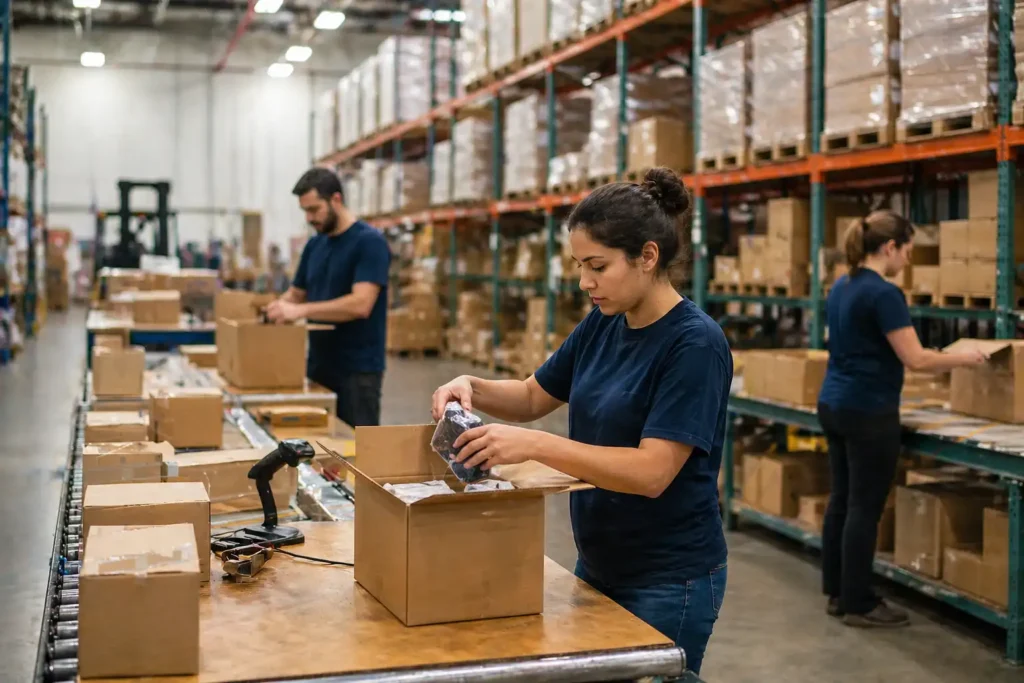
Pick and pack is one of those logistics terms that gets used constantly but rarely explained clearly. At its most basic, it describes the process of selecting individual items from stored inventory — picking — and preparing them for shipment in appropriate packaging — packing. It sounds simple, but when you’re doing it at scale, across hundreds or thousands of orders per day, it becomes one of the most operationally demanding parts of a fulfillment operation.
According to the Institute for Supply Management, labor accounts for a significant portion of fulfillment center costs, and pick and pack operations are the primary driver of that labor spend. For growing businesses, the decision of whether to run pick and pack in-house or outsource it to a 3PL is one of the most consequential calls in their logistics strategy.
How Pick and Pack Fulfillment Works
The process starts when an order is received — from an ecommerce platform, an EDI system, or a manual order entry. That order triggers a pick list, which directs warehouse workers to the specific storage locations containing the ordered items. Workers pull the items, bring them to a packing station, verify the order for accuracy, choose appropriate packaging materials, pack the order, apply a shipping label, and send it to the outbound dock for carrier pickup.
In a well-run operation, this process is tight, documented, and consistently executed. Pick accuracy rates above 99.5% are achievable with good systems and trained staff. In a poorly run operation — or one that’s been patched together as volume has grown — errors compound, returns climb, and labor costs balloon as workers chase mistakes.
When In-House Pick and Pack Makes Sense
Running pick and pack in-house gives you direct control over the operation, close proximity to your inventory, and the ability to make real-time adjustments. For businesses with very low order volumes, highly specialized product handling requirements, or same-day fulfillment needs tied to a physical retail location, keeping it in-house can make sense.
The challenge is that in-house fulfillment doesn’t scale easily. Adding volume means adding space, labor, equipment, and management complexity. Peak seasons require hiring and training temporary staff on short timelines. The operational overhead of running a fulfillment center often distracts growing businesses from the product and customer work that actually drives growth.
When Outsourcing Pick and Pack Makes More Sense
Outsourcing pick and pack to a 3PL makes sense once volume is high enough to justify dedicated infrastructure, or when the operational complexity of managing fulfillment in-house is pulling focus from core business activities. A 3PL that specializes in pick and pack already has the space, systems, labor, and carrier relationships in place — you’re plugging your inventory into an operation that’s already optimized rather than building one from scratch.
The economics usually favor outsourcing earlier than most businesses expect. When you factor in the fully-loaded cost of in-house fulfillment — warehouse space, labor including benefits, packaging materials, shipping software, equipment, and management time — the per-order cost at a 3PL is often lower even before accounting for the carrier rate advantages a high-volume 3PL can negotiate.
Adcom’s Tampa warehousing and distribution operation handles pick and pack for both B2B and B2C clients from the same facility, which is especially useful for businesses managing wholesale and direct-to-consumer channels simultaneously. The Tampa warehouse location supports efficient distribution across the Southeast, reducing transit time for Florida and regional customers.
What to Look for in a Pick and Pack Partner
When evaluating a 3PL for pick and pack, ask about their pick accuracy rate and how they measure it. Understand their order management system and how it integrates with your ecommerce platform or ERP. Ask about their packaging standards — whether they use your branded packaging or generic materials, and how they handle fragile or oversized items. Find out how they manage returns and what their process is when a pick error occurs.
Transparency on these questions separates professional fulfillment partners from facilities that can store your product but haven’t built the systems to manage high-volume, high-accuracy order fulfillment. If you’re working through the broader decision of what type of warehousing structure fits your operation before committing to a pick and pack provider, our earlier overview of how overflow warehousing works during peak season covers the capacity side of that conversation.
Call Adcom at 813-887-3747 to talk through your fulfillment volume and requirements, or request a quote and we’ll follow up with a detailed breakdown of how our pick and pack operation would work for your business.
Choosing a pick and pack partner usually starts with the warehousing question, so what a public warehouse is and why businesses use one is a useful next read, and for operations shipping to both retail buyers and individual consumers, how B2B and B2C fulfillment requirements differ explains why the same 3PL needs to handle both well.