When a business decides to outsource its fulfillment, one of the first questions that comes up is whether their operation is B2B, B2C, or some mix of both. It sounds like a simple categorization, but the answer has real implications for how a 3PL needs to be set up, what services matter most, and how performance is measured. Getting this wrong — or choosing a 3PL that’s optimized for one model when you need the other — creates friction that shows up in errors, delays, and customer complaints.
According to the U.S. Census Bureau, ecommerce shipment volumes have grown significantly over the past decade, pushing many businesses that started as pure B2B operations into direct-to-consumer fulfillment — often without fully rethinking their logistics setup. Understanding the differences between these two models is the first step toward building a fulfillment operation that actually serves both.
What Makes B2B Fulfillment Different
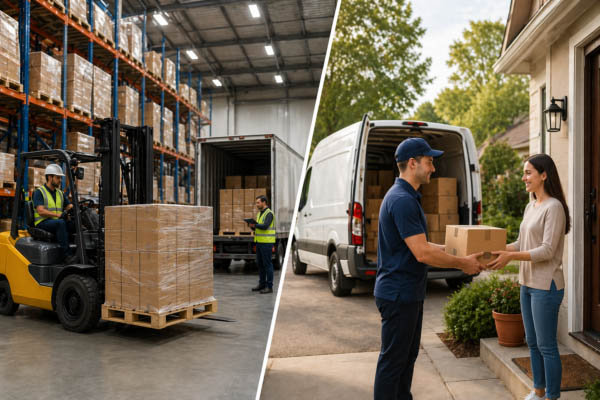
Business-to-business fulfillment typically involves larger order quantities, pallet-level shipments, and compliance requirements set by large retail buyers or distributors. If you’re shipping to a national retailer, for example, your 3PL needs to produce compliant labels, meet routing guide requirements, hit vendor compliance standards for packaging and palletization, and often provide advance ship notices (ASNs) that feed the buyer’s receiving system. Chargebacks for non-compliance are real and can be significant.
The volume per order tends to be higher and the frequency lower — a weekly or bi-weekly pallet shipment to a distribution center rather than hundreds of individual parcels per day. Lead times are typically longer, and the tolerance for error on order accuracy is high because mistakes affect large quantities of product at once.
What Makes B2C Fulfillment Different
Business-to-consumer fulfillment flips nearly all of those parameters. Orders are small — often single items — but they come in high volume and need to move fast. Consumers expect tracking information, fast transit times, and simple return processes. A 3PL handling B2C fulfillment needs the technology infrastructure to receive orders, pick and pack individual items accurately at scale, generate consumer-facing shipping labels, and provide real-time tracking visibility.
The margin for error per order is lower in absolute terms but the volume of orders means that even a small error rate — say, 1% — generates a meaningful number of customer complaints. B2C fulfillment is an operational discipline that rewards process consistency, labor efficiency, and technology integration in ways that B2B doesn’t always require.
The Hybrid Challenge
Many growing businesses operate in both channels simultaneously — selling wholesale to distributors while also running a direct ecommerce store. Managing both through a single 3PL is possible, but it requires a facility that genuinely supports both models rather than one that’s strong in one and tolerates the other.
The key questions to ask a prospective 3PL: Can they handle pallet-level B2B shipments and individual parcel B2C orders from the same inventory? Do they have the labeling and compliance capability for major retail buyers? Can they integrate with your ecommerce platform for automated order routing? Do they have the carrier relationships for both freight and parcel shipping? Adcom’s Tampa warehousing and distribution operation supports both B2B and B2C fulfillment from the same facility, which means businesses don’t need to split inventory across two providers to cover both channels.
How Your 3PL Affects Customer Experience
In B2C fulfillment, your 3PL is effectively part of your customer experience. The box that shows up at a consumer’s door — how it’s packed, whether the right item is inside, how quickly it arrived — reflects directly on your brand. A 3PL that performs poorly on accuracy or speed damages the customer relationship even if your product is excellent.
In B2B, the customer experience is more transactional, but vendor compliance still matters for your business relationships. A supplier that consistently fails routing guide requirements or ships inaccurate quantities loses buyer trust and can be subject to chargebacks that erode margins. Choosing a Tampa 3PL with strong operational discipline protects those relationships.
Choosing the Right Fit
Before signing with a 3PL, be explicit about your channel mix — what percentage of your volume is B2B versus B2C, and how that’s likely to change. A 3PL optimized heavily for one model may not scale well in the other direction. Ask for references from clients with a similar channel mix to your own, and ask specifically how they’ve handled the operational complexity of managing both.
If you’re still working through the foundational question of what kind of warehousing arrangement makes sense before choosing a fulfillment partner, our earlier look at what a public warehouse is and how it works covers the infrastructure side of that decision. Call Adcom at 813-887-3747 or request a quote to discuss your fulfillment needs directly.
Once the fulfillment model is clear, the next decision is who runs it, and freight broker vs. 3PL breaks down why those two providers aren’t interchangeable, while 3PL vs. in-house logistics covers the broader build-or-outsource decision behind that choice.