
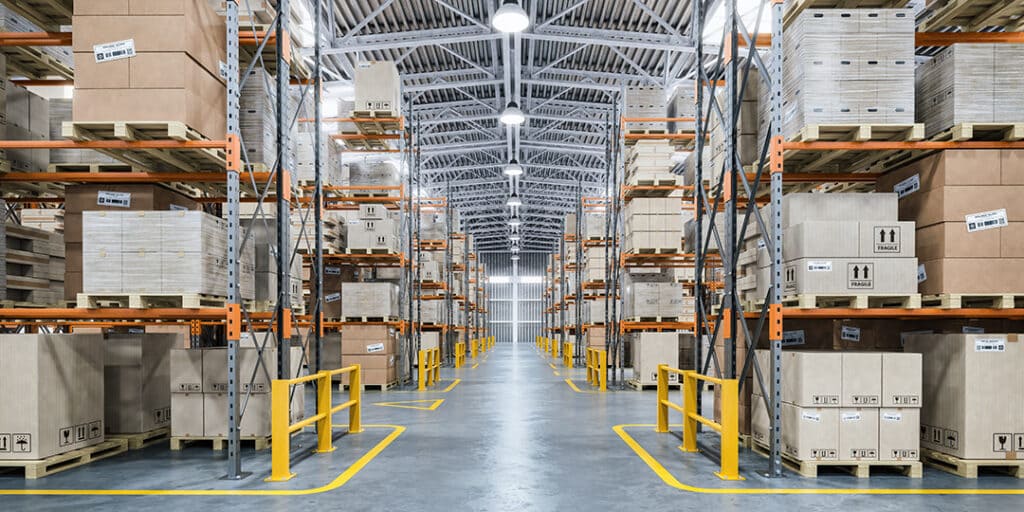
For most growing businesses, the traditional path to regional distribution looks like this: reach enough volume to justify a warehouse lease, sign a multi-year agreement, hire staff, buy equipment, and manage the operation. It’s capital-intensive, slow to set up, and hard to unwind if your distribution needs change. For businesses that want regional reach without that kind of commitment, there’s a more flexible path — using a third-party logistics provider as a distribution hub in place of a leased facility.
According to the Bureau of Transportation Statistics, regional distribution density continues to shift as businesses optimize for proximity to end customers rather than proximity to their own facilities. The businesses doing this most effectively aren’t necessarily the ones with the most warehouse space — they’re the ones with the right logistics partnerships in the right locations.
What Regional Distribution Through a 3PL Actually Looks Like
Instead of leasing and operating your own regional warehouse, you place inventory at a 3PL facility in your target distribution region. The 3PL receives inbound freight, stores it, picks and packs orders, and handles outbound distribution to your customers — all without you owning a single square foot of warehouse space or employing a single warehouse worker in that region.
Your role shifts from managing a warehouse operation to managing a vendor relationship and monitoring performance metrics. You’re responsible for making sure inventory gets to the 3PL on time and in good shape. The 3PL is responsible for everything that happens after it arrives through final delivery to your customer. The arrangement can typically be activated faster than a direct lease and scaled up or down with much less friction.
Why Tampa Makes Sense as a Southeast Distribution Hub
Location is the most important variable in regional distribution. A 3PL hub in the wrong location forces longer transit times, higher per-shipment costs, and reduced service levels — which defeats the purpose of having regional distribution in the first place.
Tampa sits at the intersection of I-4, I-75, and I-275, giving it natural access to Central Florida, South Florida, the Gulf Coast, and north-south interstate lanes. For businesses serving Florida customers — or any customer in the broader Southeast corridor — a Tampa-based distribution hub reaches the vast majority of the Florida population within a one to two day ground transit window. Adcom’s Tampa warehouse, located three minutes from Tampa International Airport, adds air freight optionality for time-sensitive shipments without requiring a separate facility relationship.
Cross-Docking as a Distribution Tool
Not every product that moves through a regional hub needs to be stored. For businesses with regular inbound freight that’s already committed to specific customers or distribution points, cross-docking can route freight from inbound to outbound without storage in between. This reduces handling costs, eliminates storage fees for fast-moving product, and accelerates the move from supplier to end customer.
A regional distribution setup that combines warehousing for steady-state inventory with cross-docking for committed freight gives you the efficiency benefits of both models — stored inventory available for orders on demand, and cross-docked freight moving through without accumulating storage cost.
Managing Inventory Visibility Across a Distributed Network
One concern businesses often raise about using a 3PL for regional distribution is inventory visibility — the worry that once product leaves your facility and sits in a third-party warehouse, you lose track of what you have and where it is. A well-run 3PL addresses this through inventory management systems that give clients real-time visibility into stock levels, inbound receipts, order status, and outbound shipments.
Before committing to a 3PL relationship, ask specifically how they handle inventory reporting — what system they use, how frequently it’s updated, and how you’ll access it. The answer tells you a lot about how professionally the operation is run.
Where Cross-Docking Services in Tampa Fit a Regional Hub
The cross-docking piece of this model depends on a facility built for fast turns. Adcom’s cross-docking services in Tampa page covers the same-day transfer capability this regional hub model relies on.
When to Consider Adding a Second Regional Hub
A single Tampa hub covers Florida and much of the Southeast efficiently. As your customer base expands nationally, the economics of a second hub — in the Mid-Atlantic, Midwest, or West Coast — eventually make sense. The right time to evaluate this is when your East Coast shipping data shows a consistent pattern of customers in regions where a Tampa hub requires 3+ day transit times and where the density of orders justifies the additional inventory commitment.
If you’re still building the case internally for this kind of move, our earlier look at B2B vs. B2C fulfillment covers how the channel mix affects these distribution decisions. Adcom’s warehousing and distribution team can help model what a Tampa-based regional distribution setup would look like for your specific volume and customer geography. Call 813-887-3747 or request a quote to get started.
For inventory that requires temperature control, a cold warehousing distribution partner handles the storage side, while cold chain logistics requirements covers what shippers need to get right across every handoff.